
Technical Description of a Graphics Processing Unit (GPU)
Karim Khalil
Department of English, CCNY
ENGL 20107: Writing for Engineering
Prof: Sara Jacobson
March 19, 2025
Table of content
| Content | Page # |
| Introduction | 3 |
| External Parts of a GPU | 4-5 |
| Interior components of a GPU | 5-6 |
| How a GPU works | 6-7 |
| Conclusion | 7 |
| References | 8 |
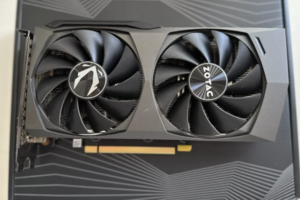
Figure 1. Zotac graphics card showing external cooling fans and PCB. This image displays the exterior of a GPU, including dual-fan cooling for heat dissipation and the golden PCIe connector at the bottom for motherboard interface. (Source: personal photo, Karim Khalil)
Introduction
Graphics Processing Unit (GPU) is perhaps the single most vital part of today’s computation. Originally designed to accelerate image rendering used in computer games, today’s GPU has turned into a general-purpose processor used in artificial intelligence (AI), machine learning, video editing, and high-performance applications. The evolution of GPU can be traced to approximately the late 1990s with players like NVIDIA and AMD (formerly ATI) developing special hardware to deal with more complex visual graphics. The GPU has progressed by leaps and bounds over time with more computations at a higher level without consuming more power. This technical primer will present a detailed explanation of the key constituents of a GPU detailing outer and inner structures and their integration to perform high-speed parallel processing.
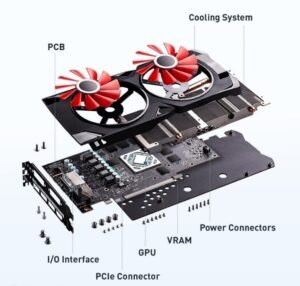
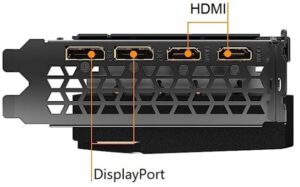
Figure 2. Diagram showing both internal and external components of a GPU. The exploded view on the left displays internal parts like the GPU chip, VRAM, PCIe connector, and cooling system. The right side shows output interfaces including HDMI and DisplayPort. (Source: Adapted from a public GPU diagram)
External Parts of a GPU
A GPU has several external components that make it operational and compatible with a computer system. Some of the external components include the Printed Circuit Board, the cooling system, power connectors, and display ports.
1- Printed Circuit Board (PCB)
The PCB serves as the foundation of the GPU, where the internal components, electrical pathways, and connectors are housed. The PCB consists of layers of copper traces that transmit the electrical signals throughout the different components of the GPU.
- Cooling System
As GPUs are powerful computationally, they generate a significant amount of heat. The cooling system has:
- Fans: Actively dissipate heat by circulating air over the components on the GPU.
- Heat Sinks: Passive metal heat dissipaters that transfer heat away from the GPU core and dissipate it.
- Liquid Cooling (optional): High-end GPUs may use liquid cooling solutions for enhanced thermal management.
- Power Connectors
These powerful GPUs require power supplied by the power supply unit (PSU) via the use of 6-pin, 8-pin, or even 12-pin connectors, as well as that supplied through the PCIe connector on the motherboard.
- Display Ports
Modern GPUs are equipped with several display output interfaces that include HDMI, DisplayPort, and USB-C. They offer the ability to connect monitors and other display devices, and support high resolutions and refresh rates.
Interior components of a GPU
In the GPU, a number of sophisticated components work together to perform graphical and computational operations effectively. These include the GPU core, the video memory, or VRAM, power delivery system, and bus interface.
- GPU Core (Processor Unit)
The core, the heart of the GPU, has thousands of distinct individual units known as CUDA cores (NVIDIA) or Stream Processors (AMD). The cores operate in parallel, allowing the GPU to handle multiple operations at the same time. While CPUs are designed for sequential processing, GPUs are designed for parallel calculation, which makes the latter suitable for graphics rendering and AI computations.
- VRAM (Video Random Access Memory)
Textures, frame buffers, and other graphical data are kept in VRAM, which the GPU can retrieve quickly during rendering. GDDR6 and HBM (High Bandwidth Memory) are the most widespread types of VRAM on modern GPUs, with increased speed and capacities providing the boost in performance.
- Power Delivery System
- Voltage Regulator Modules (VRM): Regulate the power supply to the GPU components
- MOSFETs and capacitors: Supply stable power and prevent voltage spikes that could damage the GPU.
- PCIe Bus Interface
A GPU’s primary function is to accelerate graphical computations with the power of parallel processing. While CPUs handle one or a few complicated operations simultaneously, GPUs divide workloads into thousands of minuscule operations and handle all at the same time. Parallelism renders GPUs ideal for:
How a GPU Works
A GPU’s primary function is to accelerate graphical computations through the use of parallel processing. Unlike CPUs, which handle one or a few complicated operations simultaneously, GPUs divide up workloads into thousands of little operations and handle all of them at the same time. Parallelism makes GPUs well-suited for:
- Rendering Graphics
- Rasterization: Converts 3D models to their 2D representation by drawing pixels on the display.
- Shaders: Perform complex lighting and texturing calculations to create visual realism.
- Ray Tracing: Renders real-world lighting to create accurate reflections and shadows.
- AI and Computational Workloads
- Deep Learning: Neural networks are accelerated in training and inference by GPUs.
- Data processing: Used in scientific modeling, finance modeling, weather forecasting.
- Cryptocurrency Mining: Performs mathematical calculations to verify blockchain.
Conclusion
GPUs have evolved significantly from picture rendering processors to very compute-heavy computational units with ubiquitous applications. With their high degree of parallelism, their significance as part of current computing, not to mention in AI, gaming, and data science, cannot be emphasized enough. With the evolving technology, future GPUs are more likely to have more power-efficient designs, more computing power, and interface with new applications such as quantum computing and real-time photorealistic rendering.
References
Olena. (2018, June 14). A Brief History of GPU – altumea – Medium. Medium. https://medium.com/altumea/a-brief-history-of-gpu-47d98d6a0f8a
Lheureux, A. (2022, July 13). A complete anatomy of a graphics card: Case study of the NVIDIA A100. Paperspace by DigitalOcean Blog. https://blog.paperspace.com/a-complete-anatomy-of-a-graphics-card-case-study-of-the-nvidia-a100/
AMD. (2020). Graphics processor architecture and performance analysis. Retrieved from https://www.amd.com/
How GPU Computing works | GTC Digital April 2021 | NVIDIA On-Demand. (n.d.). [Video]. NVIDIA. https://www.nvidia.com/en-us/on-demand/session/gtcspring21-s31151/

